Galleries


Greenhouse gases
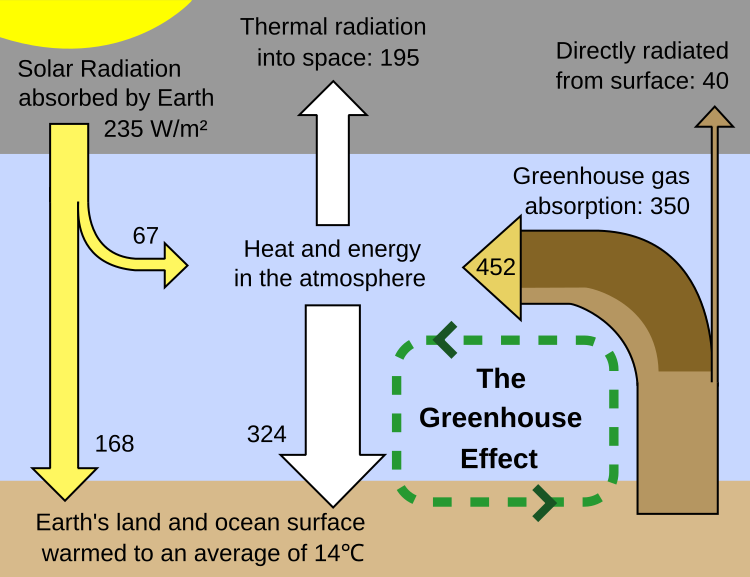 The greenhouse effect is the process by which absorption and emission of infrared radiation by gases in the atmosphere warm a planet's lower atmosphere and surface. It was proposed by Joseph Fourier in 1824, discovered in 1860 by John Tyndall, was first investigated quantitatively by Svante Arrhenius in 1896, and was developed in the 1930s through 1960s by Guy Stewart Callendar.
Naturally occurring amounts of greenhouse gases have a mean warming effect of about 33 °C (59 °F).[C] Without the earth's atmosphere the temperature across almost the entire surface of the earth would be below freezing. The major greenhouse gases are water vapor, which causes about 36–70% of the greenhouse effect; carbon dioxide (CO2), which causes 9–26%; methane (CH4), which causes 4–9%; and ozone (O3), which causes 3–7%.Clouds also affect the radiation balance through cloud forcings similar to greenhouse gases.
Human activity since the Industrial Revolution has increased the amount of greenhouse gases in the atmosphere, leading to increased radiative forcing from CO2, methane, tropospheric ozone, CFCs and nitrous oxide. According to work published in 2007, the concentrations of CO2 and methane have increased by 36% and 148% respectively since 1750. These levels are much higher than at any time during the last 800,000 years, the period for which reliable data has been extracted from ice cores. Less direct geological evidence indicates that CO2 values higher than this were last seen about 20 million years ago. Fossil fuel burning has produced about three-quarters of the increase in CO2 from human activity over the past 20 years. The rest of this increase is caused mostly by changes in land-use, particularly deforestation. Estimates of global CO2 emissions in 2011 from fossil fuel combustion, including cement production and gas flaring, was 34.8 billion tonnes (9.5 ± 0.5 PgC), an increase of 54% above emissions in 1990. Coal burning was responsible for 43% of the total emissions, oil 34%, gas 18%, cement 4.9% and gas flaring 0.7% In May 2013, it was reported that readings for CO2 taken at the world's primary benchmark site in Mauna Loa surpassed 400 ppm. According to professor Brian Hoskins, this is likely the first time CO2 levels have been this high for about 4.5 million years.
Over the last three decades of the 20th century, gross domestic product per capita and population growth were the main drivers of increases in greenhouse gas emissions. CO2 emissions are continuing to rise due to the burning of fossil fuels and land-use change.Emissions can be attributed to different regions, e.g., see the figure opposite. Attribution of emissions due to land-use change is a controversial issue.
Emissions scenarios, estimates of changes in future emission levels of greenhouse gases, have been projected that depend upon uncertain economic, sociological, technological, and natural developments. In most scenarios, emissions continue to rise over the century, while in a few, emissions are reduced. Fossil fuel reserves are abundant, and will not limit carbon emissions in the 21st century. Emission scenarios, combined with modelling of the carbon cycle, have been used to produce estimates of how atmospheric concentrations of greenhouse gases might change in the future. Using the six IPCC SRES "marker" scenarios, models suggest that by the year 2100, the atmospheric concentration of CO2 could range between 541 and 970 ppm. This is an increase of 90–250% above the concentration in the year 1750.
The popular media and the public often confuse global warming with ozone depletion, i.e., the destruction of stratospheric ozone by chlorofluorocarbons. Although there are a few areas of linkage, the relationship between the two is not strong. Reduced stratospheric ozone has had a slight cooling influence on surface temperatures, while increased tropospheric ozone has had a somewhat larger warming effect.
Subscribe to:
Comments
(Atom)